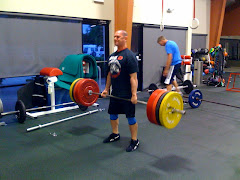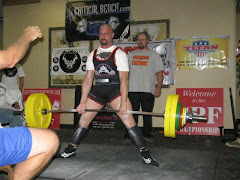
Friday, October 10, 2008

Sat. 10-11-08 BOOT CAMP

Sat. 10-11-08 BOOT CAMP:

Truck Rope Pull:  6 x 50’ then run 100 yrds. (get ready to repeat)


Tire Flips:  200lb. tire 6 x 10 flips


KB Single Arm Thrusters: 6 x 10 each arm

The Definitive Guide to the Primal Eating Plan32

Food Scale

Do the Math

In my recent Context of Calories post, I explained how the different macronutrients we eat at each meal (fats, proteins, and carbohydrates) have different effects in the body. I suggested that, despite their raw calorie values, it’s far more important to get a lasting intuitive sense of how much of each macronutrient you need and when you need it (or not).

But how do you do that? How do you figure out the proper number of calories - and breakdown of fats, protein and carbs - to accomplish your fitness and health goals? To lose weight? Lose fat? Gain muscle? Maintain status quo? Run marathons?

In fact, most popular daily diets look at overall calories as the main factor in weight loss and weight gain. The age-old conservation of energy Conventional Wisdom says that “a calorie is a calorie.” From there most diet gurus generally prescribe some formulaic one-size-fits-all breakdown of fats, protein and carbs. A classically trained Registered Dietician will tell you that protein should be around 10-15% of calories, carbs should be 60% (and mostly from whole grains) and fat under 30%. This macronutrient breakdown stays the same regardless of how much weight you need to lose or what other goals you might have. Barry Sears has his 40/30/30 “Zone” diet. The USDA bases everything on a choice of between 2,000 and 2,500 calories a day. But, as I said earlier, it’s not that simple. Calories do have context.

The human body uses these macronutrients for a variety of different functions, some of which are structural and some of which are simply to provide energy - immediately or well into the future. Moreover, with regards to energy conservation or expenditure, the body acts as both an efficient fuel storage depot (and as a toxic “waist” site) as well as a potent generator of energy, depending largely on the hormonal signals it gets. It will store glycogen and/or fat and it will build muscle - or it will just as easily tear them all down and use them for fuel - based on input from you: what you eat, how much you eat, when you eat, what you’re doing before or after you eat - even what you’re thinking when you eat. Yet because your body always seeks to achieve homeostasis over time, the notion of you trying to zero in on a precise day-to-day or meal-to-meal eating plan is generally fruitless (yes, Charlotte, some fruit is allowed). The good news in all this is that falling off the wagon once or twice this week won’t have the immediate disastrous effect that you might imagine - as long as you can keep your average intake under control and understand how the various macronutrients function over time.

Which brings me to the crux of today’s discussion. Not only is it nearly impossible to accurately gauge your exact meal-to-meal calorie and macronutrient requirements, doing so will drive you crazy. In fact, to accurately figure your true structural and functional fuel needs (and hence to achieve your goals) it’s far more effective to look at a much larger span of time, like a few weeks, and aim for an “average” consumption. Then you can review that average daily intake over weeks or months and adjust accordingly. Below, I’ll give you a way to figure a “jumping off” point to start with, but remember, our genes are accustomed to the way our ancestors ate: intermittently, sporadically, sometimes in large quantities, and sometimes not at all for days. Their bodies figured out a way to maintain homeostasis and preserve lean tissue and good health through all this and so can we. Our genes want us to be lean and fit. It’s actually quite easy as long as we eat from the long list of Primal Blueprint healthy foods and try to avoid that other list of grain-laden, sugary, processed and otherwise unhealthy foods. Realistically, we also want to allow for the occasional party-splurge, a pre-planned (or accidental) intermittent fast, an over-the-top workout or even a week of laziness. Where most people get into trouble is in miscalculating their energy needs over extended periods of time - not day-to-day. They don’t see the average amount of carbs creeping upwards, or they figure they need x amount of calories, but don’t have a clue as to what kind of food those should be coming from.

I start with these four basic principles to guide my Primal Blueprint eating style:

1) 80% of your body composition will be determined by your diet. Yes, exercise is also important to health and to speed up fat-burning and muscle-building, but most of your results will come from how you eat. I’ll write more on this later, so just trust me on this one for now. Suffice to say, people who weigh a ton and exercise a ton, but eat a ton, still tend to weigh a ton. I think I’ll have that made into a t-shirt…

2) Lean Body Mass (LBM) is the key to life. I’ve said it many times on this site: lean mass (muscle and all the rest of you that is not fat) is directly correlated with longevity and excellent health. Rather than strive to “lose weight”, most people would be better off striving to lose only fat and to build or maintain muscle. Since other organs tend to function at a level that correlates to muscle mass, the more muscle you maintain throughout life, the more “organ reserve” you’ll have (i.e. the better the rest of you will work). Refer back to rule #1 and eat to build or maintain muscle.

3) Excess body fat is bad. Most human studies show that being significantly overweight increases your risk of nearly every disease (except osteoporosis - because ironically it responds to weight-bearing activities). Fat just doesn’t look that great either. See rule #1 and eat to keep body fat relatively low.

4) Excess insulin is bad. We’ve written about it here a lot. Chronic excess insulin may be even worse than excess sugar (and we know how bad that is). All animals produce insulin, but within any species, those that produce less insulin live longer than those who produce a lot. Eat to keep insulin low.

Here is how I use these principles to guide my individual macronutrient intake:

Protein

Raw Steak

Protein takes priority. If there is ample glycogen (stored glucose) and the body is getting the rest of its energy efficiently from fats, protein will always go first towards repair or building cells or enzymes. In that context, it hardly seems fair to assign it a “burn rate” of 4 calories per gram. It’s like saying the 2×4 studs that support the walls of your house can burn nicely if you run out of firewood. They will, but I prefer to burn other fuel first. At a minimum you need .5 grams of protein per pound of lean mass/per day on average to maintain your “structure”. If you are moderately active you need .7 or .8, and if you are an active athlete you need as much as 1 gram of protein per pound of lean mass. That’s at a minimum, but it’s on a daily average. So a 155 lb moderately active woman who has 25% body fat (and thus) has 116 lb of lean body mass needs 93 grams of protein on average per day (116 x .8). If she gets 60 or 80 some days and 110 on others, she’ll still be in a healthy average range. And even if she exceeds the 110, it’s no problem if she’s eating low carb because the excess protein will convert to glucose, which will reduce her effective carbohydrate needs (see below). At 4 calories per gram, that’s between 320 and 440 calories per day in protein. It’s not that much.

Carbs

Vegetables

If you’ve forgotten everything you ever learned in biology, just remember this and “own” it: Carbohydrate drives insulin drives fat (Cahill 1965, and Taubes 2007). The idea in the PB is to limit your carbs to only those you need to provide glucose for the brain and for some reasonable amount (certainly less than an hour) of occasional anaerobic exercise. And the truth is, you don’t even need glucose to fuel the brain. Ketones from a very-low carb diet work extremely efficiently at that task. Either way, ideally, we would like most of our daily energy to come from dietary or stored fats. Typically, (if you are at an ideal body composition now) I use a rule of thumb that 100-150 grams of carbohydrate per day is plenty to keep you out of ketosis (and ketosis is NOT a bad thing) but away from storing the excess as fat if you are the least bit active. Don’t forget that your body can make up to 200 grams of glycogen from fats and protein every day, too. On the other hand, if you are looking to lose body fat, keeping carbs to under 80 grams per day will help immensely in lowering insulin and taking fat out of storage. On the other other hand, if you are insistent on training hard for long periods of time, you would add more carbs (say, 100 per day extra for every extra hour you train hard). It becomes a matter of doing the math and experimenting with the results.

Ironically, it’s tough to exceed 100 grams of carbs even if you eat tons of colorful vegetables - as long as you eat like our ancestors and consume no grains, no sugars and few starchy vegetables (potatoes, yams, beets, legumes, etc). Even if you eat a ton of vegetables AND a fair amount of fruit, you’ll be hard pressed to exceed 150 grams of carbs on average per day. Our remote ancestors couldn’t average 150 grams of carbs a day if they tried, yet they had plenty of energy and maintained their lean mass. At 4 calories per gram that’s only between 400 and 600 calories per day. Add that in to the protein above and our sample girl is barely at 1,000 calories on the high end. So where does the rest of the fuel come from?

Fats

Olive Oil

Learn to love them. They are the fuel of choice and should become the balance of your Primal Blueprint dietFats have little or no impact on insulin and, as a result, promote the burning of both dietary and stored (adipose) fat as fuel. Think about this: if protein and carbs stay fairly constant (and carbs stay under 150), you can use fat as the major energy variable in your diet. Feeling like you need more fuel (and you’ve already covered your bases with protein and carbs)? Reach for something with fat. Nuts, avocados, coconut, eggs, butter, olive oil, fish, chicken, lamb, beef, the list is a long one. 100 grams of fats per day would only add 900 calories to our girl’s daily average, putting her at between 1620 and 1940 calories a day. Even if she averages somewhere between 1400 and 2200 calories per day over a few weeks, as long as she pays attention to protein and carbs, her body composition will shift to lower body fat and more desirable lean mass. If she decides to do some walking, a few brief intense weight sessions and asprint day here and there, that process would accelerate greatly. If she gets to a point where she’s content with her body fat, she can even add in a little more fat to provide energy that she previously got from her stored fat.

The main thing I’ve figured out from eating this way for years is that I don’t need nearly as many calories to maintain health, mass, and body fat as I once thought I did - or as the Conventional Wisdom says I do. I eat 600-1000 calories per day less than when I ate a carbohydrate-based diet, yet I maintain slightly lower body fat and slightly higher muscle mass on even less training. Remember: 80% of body composition is determined by diet. The best part is that I don’t ever feel hungry because I base my eating on exactly what my 10,000-year-old genes want me to eat.

Further Reading:

Definitive Guides to:

The Primal Blueprint

Grains

Fats

Cholesterol

Insulin, Blood Sugar and Type 2 Diabetes

Stress, Cortisol and the Adrenals 

Thursday, October 9, 2008

Fri. 10-10-08 W.O.D.:

Fri. 10-10-08 W.O.D.:

Power Cleans:  (Rest 1-2 min. between sets)

Form and Technique Practice for 20 min.


W.O.D.: AMRAP in 20 min.

1-lap around the bldg.: 


Sumo Deadlift High Pulls: x10


Hanging Knees to Elbows x 20

Zydrunas Savickas 

Yoke Carries 1,100 pounds at 2008 AC

Walk now for Autism

Hello family and friends,

I am participating in Walk Now for Autism to help find a cure for autism. Autism is the second most common developmental disorder in the United States affecting one in every 150 children born today. Despite some promising discoveries, the cause of autism is unknown and a cure does not exist. Research is crucial. Every 20 minutes another child is diagnosed with autism. Not only must we find ways to improve the quality of life for children and adults with autism, but we also must find a cure, and soon. 

Walk Now for Autism is our chance to make a difference in the fight against autism by raising money for autism research and heightening public awareness. Please join me in my fight as I raise $2,000 to help fund essential research. I will be walking on November 8th and would like you to support those affected by autism. You can donate to Walk Now for Autism and join my team online through my webpage at www.walknowforautism.org. Donations can also be mailed to Autism Speaks using the donation form located on my page or send me a check made out to Autism Speaks. My team name is 'Marching for Mandy,' please note this on your check and the donation form. 

Please join me in my fight against autism. Thank you for making a difference in the lives of the more than 1 million Americans living with autism today. 

Sincerely, 

Julie Stachler
Donations are tax deductible to the fullest extent allowed by law. 
Autism Speaks 501 (C)(3) Tax Id #: 20-2329938 

MATCHING GIFT PROGRAM Many companies provide their employees with matching gifts. Please consult your employer on its matching gift guidelines and attach matching gift forms accordingly.

Follow this link to visit Julie Stachler's page.

Julie Stachler

Wednesday, October 8, 2008

FREE Sports Nutritional Seminar

Join Certified Sports Nutritionist, Mary McCormack, RD, for an informative discussion on eating to fuel your active lifestyle, Sponsored by Wayne M. Burr, MD, Concierge Medicine, Mary will give you information on maximizing your workouts and the results that you want from them, fueling your workouts and other athletic endeavors, and how to best meet nutritional needs for your active lifestyle. Mary has a lot of practical tips and will allow plenty of time for questions and discussion. Don't miss this opportunity to learn from an expert!
 

What you'll learn:

  • Choosing the best fuel
  • What kind of carbs to choose
  • How much protein
  • How to increase energy
  • Important nutrients
  • Balancing your diet
  • Sports Drinks & Hydrating

When: Thurs October 16th, 6:45 PM

Where: The Training Ground

Cost: Your Time


Please register via email or at the front desk.

 
THE TRAINING GROUND
13211 McGregor Blvd
Ft. Myers, FL 33919
239-437-3488

Here's a little something extra for you.

(from crossfithardcore - Boca)   Courtesy of our friends at CrossFit Harbor City 

Our clients get it. These people don't. As compiled from the CrossFit.com message boards. (with rebuttals)
• “It's too hard” (Is anything worthwhile EASY?)
• "I don't have the time" (Huh? In the time it takes you to finish this you could have done 50 squats)
• "I want to get in shape before starting a program like that." (Obviously lame, how do you propose to get started?)
• "Dude, that workout would kill me." (Being fat and sick won’t?)
• "I'm sure I'd lose size if I did that." (What size, Arnold?)
• “It costs too much” ( The workouts are FREE, Great coaching is what you pay for)
• "It's too intense for me." (Yep. Probably is. That’s the POINT)
• "Lifting that much weight is unsafe." (So is sex and skydiving)
• "You have to be very careful doing dead lifts and squatting that low" (No, you should be CAPABLE, not careful)
• "You'll throw up if you go that hard, that fast." (Maybe, but probably not, and if you do, SO WHAT?)
• "I can't do 100 PULLUPS” (All at once? neither can we) 
• "looks like a fad" (So did the internet)
• "I heard that stuff was dangerous" (you HEARD that? From who?)
• "I don't want/need to be stronger, I just want to be healthy by running and going to spin class" (You DO want and NEED to be stronger - running and spinning do the opposite)
• "I need to quit smoking first." (You’re right!)


Tuesday, October 7, 2008

Eat This, Not That

BY DAVID ZINCZENKO, WITH MATT GOULDING

Eat This, Not That

Secrets That Restaurants Don't Want You To KnowPosted Mon, Sep 08, 2008, 7:00 pm PDT

85% of users found this article helpful.

Restaurants have one major purpose: to stuff you with as much food as they possibly can. If they do that, they achieve their primary business goal, which is to lighten your wallet.

But while they’re doing that, they’re also using their best marketing tricks, craftiest numerical switcheroos, and most dastardly dietary stratagems to swap unhealthy, cheap ingredients for more expensive, wholesome ones. The result: bloated bottom lines — for their budgets, and for their customers. But we don’t want to let that happen to you, which is why we’ve spent the last two years researching all the ways restaurants try to sabotage your food choices. 
 
Below you’ll find a sampling of the fruits of our long labor: some of the new secrets the restaurant-chain gang doesn’t want you to know. They’re only a few of the many ways restaurants fatten up their customers for the sales slaughter. Heed the warnings and you (and your family) can make it through the drive-thru alive. 

1. Baskin-Robbins doesn't want you to know that.....
 
Sometimes a drink can have fruit in the title, but not in the cup. For instance, the top four ingredients in its Blue Raspberry Fruit Blast were Sierra Mist soda, water, sugar, and corn syrup. Since we first called the company out on this fruitless horror, Baskin-Robbins discontinued the Blue Raspberry Fruit Blast. The company also began listing all nutrition and ingredient information online. We call that progress. 

If you’re looking for a real fruit smoothie, visit Jamba Juice. Just remember to check those calorie counts, so you don’t over-indulge.
 
2. Papa John's doesn't want you to know that... 
 
Unlike rival chains such as Domino's, it has made little effort to introduce healthier options. After we goaded them on their slow pace of innovation, Papa John's did introduce whole grain wheat crust pizzas last May. Now, if only Papa would toss a thin-crust version into the mix and alter the recipe for sides like cheesesticks, which are loaded down with more than 2,900 milligrams of sodium!
 
3. Fuddruckers doesn't want you to know...
 
The fat content of its 1-pound burgers. We contacted our local Fuddruckers restaurant and were told that the nutritional information was available on the chain's Web site (it's not). The corporate office later responded that providing such information would be "very extensive and timely." We're pretty sure he meant "very expensive and time-consuming." How's that for a Freudian slip?

4. Panera Bread doesn't want you to know that... 
 
The synthetic food colorings in its pastries have been linked to irritability, restlessness, and sleep disturbances in children. And British researchers found that artificial food colorings and preservatives in the diets of 3-year-olds caused an increase in hyperactive behavior. The same ingredients appear in fast-food items like mayonnaise, M&M Blizzards, and McDonald's shakes.

On Panera's Web site, you can track down calories, fat, sugar, and other nutritional numbers. If you look hard enough you'll find ingredient lists, too — and note that a few items still contain artificial coloring. Disappointing. If you want to cut out the artificial stuff entirely, head over to Chipotle: The restaurant uses no artificial colorings or flavorings. Just make sure you saw their burritos, which can have more than 1,000 calories, in half.
 
5. Chevy's Fresh Mex doesn't want you to know ...
 
How its tortillas stack up nutritionally. The chain says it provides "nutritional information regarding calories, fat, protein & carbohydrates for some of our most popular items" — the chicken, steak, and shrimp fajitas, for example — on its Web site. But the numbers provided don't include the tortilla: an essential component typically bloated with fat and carbs. When we called a New York Chevy’s for more information, a server told us he couldn't find that info on the in-house menu, either, which would seem to be a violation of New York city regulations. He did direct us to the same misleading nutritional information on the company's Web site. Gee, thanks.
 
6. Applebee’s, IHOP, Olive Garden, Outback, Red Lobster, and T.G.I. Friday’s don’t want you to know ...
 
The nutritional impact of their dishes. Despite the fact that we continued to pester each company, they all were mum about their nutritional information. So we had it nutritionally analyzed on our own. We may not be in this fix for long, however. New York City regulations that went into effect in July require all restaurants with 15 or more branches nationally to post calorie counts on their menus.

After tracking down every last dish, we can see what they were hiding: At Friday’s, no fewer than nine sandwiches and 10 appetizers topple the 1,000-calorie barrier; at IHOP, the “healthiest” entrée-size salad has a staggering 1,050 calories; and at Outback, even a simple order of salmon will wipe out 75% of your day’s caloric allotment.  

For more restaurant industry secrets that will freak the weight right off of you, check out these other dubious restaurant secrets that are being hidden from you!

And lose weight in record time by staying away from the unhealthiest drinks in America! They can be responsible for causing you to gain a few pounds of fat — a month!

And now that you’re aware of the danger, do us all a favor: if you notice other big fat restaurant lies, let us know. Likewise, if you’ve found ways to cut through the fast-food jungle without getting eaten, let us know that, too. When it comes to the battle of the restaurant bulge, we’re all in this together.

- - - - - - - - - - - - -


Want the most up-to-date nutrition secrets and breaking research science from Eat This Not That? Sign up for the free weekly newsletter.

And introducing: Eat This, Not That Mobile! Now get the exclusive healthy eating info you need at any market, restaurant or roadside stand—instantly!

More nutrition, health, and fitness secrets from Men's Health: Subscribe today with this special offer and save 50% off the cover price.

Build wealth, beat stress, and live at the top of your game! Tap the money, romance, and weight-loss power of Best Life. Save 80% off the cover price!

Buy the book! Special price on Yahoo! Shopping.


Now on sale! A new book for parents and kids. Buy now.


Wed. 10-8-08 W.O.D.:

Wed 10-8-08 W.O.D..:

Squats: (Rest 1-2 min. between sets)


1x12,   1x10,   1x8,    2x6,  2x4


W.O.D.: Complete 4 Rounds / exercise before moving to next exercise.

60 Sec. per exercise with 20 sec. rest between rounds. 1 min. rest between stations.


Over Head KB Lunges


Wall Ball Shots


Lateral Lunges


Medicine Ball Sit Up with heels pulled into groin


L-Sits

Arnold Strongman 2008 

Zydrunas Savickas 1066 lb. Hummer Deadlift

Pregnancy- No longer an excuse!

What it Takes

Carey Kepler, Co-founder of CrossFit Central and the CrossFit Woman Program is many things to many people. She is a wife, mother of two, triathlete, marathon runner, personal trainer, and CrossFit Coach. While she was pregnant with her second child Carey continued to CrossFit up until the day she gave birth. Austin Woman recently coined her the modern day super woman. Since that time Carey has returned to training and has lost all of the weight she gained while pregnant. Some say Carey was able to get back into shape 5 months after giving birth because she is genetically better off than others. Carey tells a different tale.

Five months and two weeks ago I met Carey at the gym for an interview and a workout. Her hair was pulled loosely away from her face and piled on top of her head. Tennis Shoes, lose black pants, and a Fight Gone Bad shirt – she was a pregnant woman on the go. It was exactly two weeks until her due date and as she wrote her workout on the white board I began to wonder if I could do that workout. I mean sure, I could do it but I’d have to modify just about everything. I thought to myself, “I bet at 9 months pregnant she could kick my ass in a CrossFit workout.” She bounded over with a huge smile, the kind that makes the corners of your mouth turn up until you’re grinning ear to ear, trying desperately to figure out the punch line. “Are you ready for this?” Sheasked me. I looked down at my college lined notebook and ball point pen, “Yep, Are you?” she started laughing. I scribbled the workout down in my notebook:


Post CrossFit Cert Chipper As Rx'd:
25 Walking Lunges
20 Pull ups
50 Box Jumps
20 Double Unders
25 Ring Dips
20 Knees to Elbows
30 Kettlebell Swings
30 Sit Ups
20 Hang Squat Clean
25 Back Extensions
30 Wall Ball
3 Rope Climb

Scaled 9 Months Pregnant Chipper:
20 Walking Lunges
20 Pull Ups
25 Step Ups on a Box
25 Ring Dips
20 Kettlebell Swings

“Whoa, wait a minute you’re going to do pull ups?” “Yep, I can only get a few in a row now” I grabbed the stop watch and asked again if she was ready - giving her any reason to bail and go have lunch instead. But when I glanced over I saw that the noise around her had faded into the background. Carey was focused on her body and the workout ahead. “3,2,1 Go!” She moved through the workout steadily and was careful not to push herself too hard. She monitored herself every step of the way, and when she finished she yelled “Time!”

I was amazed! Here was a woman who by all definitions should be taking things easy, but she was still training her clients, completing modified workouts, finding time for her family and friends, and doping pull ups! After the birth of her 1st child, Carey got back into shape by training for an Iron Man. At CrossFit HQ she was filmed doing A Post CrossFit Cert. Chipper. This happened to be filmed a few weeks before she found out she was pregnant with her second child.


Carey’s work requires early mornings and staying motivated and active throughout the day. Juggling the different part of her life saw it’s fair share of struggles “Throughout my pregnancy I had long days but I was able to maintain what I normally did – I worked through it – but I was in bed by 9pm every night. I make a point to be present all of my day so I don’t neglect parts of my life. I take advantage of my free time. I think I have it good because I get to see my kids all day where some women have to work away from their kids. We all juggle different things but we have to be present in the moment for our clients and our family.”

She admits that this pregnancy was more difficult than her first. “I had to wear support hoes, I was more exhausted than I’ve ever been, I had to prop my feet up, and my abdominal muscles separated.”

Carey knew that getting back into shape wouldn’t be easy. Her abs separated during pregnancy, which meant paying closer attention to her body and easing back into training. “I have to be safe not to jump too quickly and take it easy. 2 weeks after I gave birth I began walking for 15 minutes. I first started walking in sandals so I wouldn’t be tempted to go at a quick pace. Then I started with a 1 minute walk, 2 minute jog – gradually I decreased my walking and increased my running. It’s not about getting back into the race. It’s about healing my body”

Five Months later Carey and I met up again for an Interview and a Workout. Black shorts, a white V-neck tank, and tennies – still a woman on the go. She bounded over with a huge smile “Let’s do this!” This time the Chipper was the same as before she was pregnant – no modification. To date she has lost all of the weight she gained while pregnant. Some say she is genetically pre-dispositioned to lose the weight faster than others. 
Some claim that it’s just something about Carey, she is special and a modern day super woman, and other women couldn’t possibly do the same thing. “No way was getting back into shape easy! It was tough. I had to watch what I ate, I had to CrossFit regularly. I watched myself teeter on the scale - lose a few pounds and gain a few more.”

When asked whats the secret she replied “You just have to get out there and make it happen. Just do it. Eat right, join a program, and stay consistent! That’s the secret.” Carey plans to expand the Crossfit Women’s program and spread real fitness to women all across Austin. She intends to “empower women, challenge women, and have them realize what they’re capable of." "All women can do what I did. Whether it’s needing to dial in on your food, your workouts , strength, or endurance – I’ve been through it and so have the other women in this program. That’s what it’s all about, coming together with like-minded people for a common goal – and that goal is to play an active role in your life.”

Carey Kepler has been training in Austin, TX for 10 years. She has been an athlete all of her life and has a strong passion to work with individuals ready to change their overall wellness and quality of life. Carey specializes in functional training for athletes and strength development of function for life. She is a triathlete of 7 years and has competed in sprint to ironman distance races. Carey has a BS in Kinesiology from Angelo State University, she is a Level II CrossFit Coach, and a Level I USAT Triathlon coach. Find Out More about Carey Kepler athttp://careykepler.blogspot.com


Monday, October 6, 2008

Tues. 10-7-08 W.O.D.:

Tues 10-7-08 W.O.D.:.:

Push Press: (Rest 1-2 min. between sets)


1x12,   1x10,   1x8,   2x6,   2x4


W.O.D.: Complete AMRAP in 25 min.


10- Burpees (Use MB with handles)


10- Medicine Ball Push Ups


10- Dips (on rings, parallet bars or dip bar)


10- MB Rotational Slams per side

Crossfit - 60 year old Snatch/Clean

Sunday, October 5, 2008

Mon. 10-6-08 W.O.D.:

Mon. 10-6-08 W.O.D.: 

Deadlift: (Rest 1-2 min. between sets)

1x10,    1x8,    2x5,    2x3


W.O.D.: Complete 3 Rounds / exercise before moving to next exercise.

60 Sec. per exercise with 20 sec. rest between rounds. 1 min. rest between stations.


Pull Ups on Rings:


Kettlebell Swings:


Kettlebell Plank Rows:


Glute/Ham Developer Hyperextensions


Sinlge Arm Touch Downs

CrossFit Camp Pendleton

CrossFit prepares them to protect our country

Saturday, October 4, 2008

Thank You CrossFitters

Hey CrossFitters,

Today I received a special gift from Julie Racicot-Taylor and my CrossFit members. Julie presented me with a beautiful hand made quilt with many inspirational quotes from my members and pictures of all the great moments we've shared in class. All of you have become family to me and I want each one of you to know how much you mean to me. I truly appreciate the time and energy invested in this gift and I will treasure this always.

Thanks for always being there for me Crossfitters,

Jeremy Barnett

Friday, October 3, 2008

Sat.10-4-08 BOOT CAMP.:

Sat. 10-4-08 Boot Camp:


Complete 4 Rounds: 60 Sec. / Exercise (rest 20 sec. between rounds)

Station #1: Overhead Plate Carry (50 ft. down and back)

Station #2: KB 1-arm Deadlift  High Pulls each (2 rounds right arm, 2 rounds left arm)

Station #3: Burpees

Station #4: Wall Ball Shots

Station #5: MB Trunk Rotations Seated


Georges Labrecque world stongest grand-pa, 

grand father, 420 lbs dead lift at 164 lbs and 82 years olds. 

CPA competition 22 october 2006 at pro gym Serge Moreau in Montreal. 

Thursday, October 2, 2008

They finally beat me!

Here we go again. The feud is on. Ryan and Dino both did a 350lb. Yoke Carry for 65 feet today beating Jeremy's 335lb. Yoke Carry record. Don't worry guys. I'll make my come back.

Don't forget Big D is coming in this weekend. He'll shoot for 400lbs. and take us all out.
Crazy 14 year old kid.

Ryan's 350 lb. Yoke Carry


Dino's 350lb. Yoke Carry


Awesome job guys! Keep up the hard work!

Wednesday, October 1, 2008

Fri. 10-2-08 W.O.D.:

Fri. 10-3-08: (Squat 10, 8, 6, 4, 2 Heavy)


(Complete 4 rounds)

20 BB Thrusters (men 75lb., women 55lb)

3 Rope Climbs

30 MB Overhead Slams

Choose Your Own Stir-Fry Adventure17

Throw it all in a pan and you’ve got dinner…

A few months ago we served up the popular “Choose Your Own Salad Adventure” post, and we got comments galore. Salads, after all, are perfect PB fare: a diverse veggie base, assorted protein pairings, and various choices for the inclusion of yummy (and filling) fats. As much as we adore our PB salads, we readily admit that salad isn’t the only contender here. We’re happy to introduce the MDA Stir-Fry Adventure. Yes, that hot, tasty, quick flash of a cooking spectacle that leaves ingredients full of nutrients and loaded with flavor. It’s one way to throw together a magnificent PB dinner with little effort and time. Got quality ingredients around? You’re good to go. Get your woks (and pans) ready. We hope you dig in.

Veggie Base

Vegetables are truly the genuine and beloved base for traditional stir fry. The options are nearly endless. Chop up your own creative combination into bite-size pieces. One to two cups per person is a good place to start.

Bok Choy

Spinach

Kale

Turnip Greens

Snow Peas

Water Chestnuts

Bamboo Shoots

Bean Sprouts

String Beans

Zucchini

Celery Cabbage

Celery

Mustard Greens

Mushrooms

Cauliflower

Broccoli

Asparagus

Bell Peppers (all colors)

Chili Peppers

Carrots

Radishes

Onions

Lesser Known Tasty Tidbits

Chinese Winter Melon

Bitter Melon

Protein Pairings

Ah, the proteinWhat’s not to love? It’s muscle-building, stick-to-your-bones goodness. Go for that stack-of-playing-cards size serving. (Or go whole hog and add more if you’re so inclined.) Cut into bite-size pieces and cook in the wok/pan for best results. Feel free to also use precooked meat (i.e. leftovers).

Chicken (light or dark meat or liver)

Duck

Turkey

Capon

Squab

Pork

Sausage

Spare Ribs (Pre-cook and serve over stir-fried veggies.)

Beef

Steak

Salmon

Shrimp

Lobster

Crab

Clams

Scallops

Squid

Halibut

Red Snapper

Sea Bass

Trout

Carp

Scrambled Egg (Add after cooking.)

Nuts (Almonds and cashews are most common. Add after cooking.)

Seeds (Sesame seeds are common. Add after cooking.)

Bean Curd/Tempeh (We’d recommend limiting bean curd, but include it in small amounts if you’re a super fan. Cook as you would meat pieces.)

Oils/Fats

Traditional stir-fry cooks food very quickly at very high heat, whereas many at-home cooks modify the method by sautéing at slightly lower temps more practical for the kitchen equipment (e.g. fry pans and regular stove) they have. Either way, you’ll be cooking at high temps. Be sure to use an oil or fat that can take the heat for the actual cooking itself and add less hearty but flavorful oils at the end. (See our “How Hot Is Too Hot?” post for some high heat selections.) Naturally refined oils, chicken fat, and light olive oil are common options.

Chicken Fat

Extra light olive oil

Refined palm or coconut oil

Refined avocado oil

Spice and Other Kicks

Spices, seasonings, sauces, and other liquid flavorings are often but not always added at the end of the cooking process. (Garlic and fresh ginger can be added first to flavor the oil and then uniformly be absorbed into the other ingredients.) For other spices and flavoring liquids, their late introduction leaves enough time for the flavor to be released without being watered down or too melded with the other flavors.

Garlic

Scallions

Parsley

Sherry

Soy Sauce

Sesame Oil

Nut Oils

Sweet Bean Sauce (hoi sin deung)

Vinegar

Ginger

Curry

Tabasco Sauce

Oyster Sauce

Celery Salt

Shrimp (or other seafood) Paste

Salt and Pepper, of course

Chicken, Beef or Fish Stock

Citrus Juice (Add after cooking.)

Looking for more in the way of how-to? We gotcha covered. Advanced and otherwise creative stir-fry cooks may have varying methods, but this should get the average novice well on the way to a great stir-fry dish.

Basic Rundown

Cut all meats and veggies into small, bite-sized pieces. (Meats can be cooked separately and then cut, but this is unnecessary if you cut your pieces small enough and use high heat.) Heat a wok or heavy fry pan without oil or liquid. Once heated, add enough oil to coat the pan. (We’ll use extra light olive oil here.) Lower the heat to medium and for 20-30 seconds heat the chopped clove of garlic and 1/3 onion. Stir these and all ingredients constantly. Add salt, pepper and meat. Return heat to high. Cook 1-2 minutes, stirring constantly. (Note: At this stage, it’s generally recommended that you remove the meat to add again later with the last ingredients. Many people also wash the pan. If you’re going for convenience, the world won’t end if you simply leave the meat in the pan and proceed.) Add bite-size pieces of veggies that are thicker or take longer to cook (e.g. broccoli, carrot slivers, finely sliced red bell pepper, mushrooms, bamboo shoots, and water chestnuts). You can also blanche larger or denser veggies prior to making the stir fry. Add 1 Tbsp. sherry. Cover and cook 1 minute without stirring. Add second group of veggies - greens and ingredients whose crispness you want to retain (e.g. snow peas, bok choy). Cook for one additional minute uncovered, stirring constantly. Add chosen spices and liquid flavorings (e.g. 1 Tbsp. low sodium soy sauce, ¼ cup chicken stock) with teaspoon of cornstarch (no, a single tsp won’t kill ya) if you desire a thicker sauce. Cook an additional 20-30 seconds. Top with scallions and dash of sesame oil if desired.

Ultimately, the brief cooking time in stir fry should preserve the individual taste and nutritional “integrity” of all the ingredients in the dish. Each veggie, meat and other ingredient should retain its own flavor but come together “just enough” through the infusion of spice and essences. The result? A culinary symphony that’s always new, always varied and sure to please.

Consider it a much healthier meal that lets you “have it your way.”

Have your own favorite combinations to share? Other ingredient options to add to the list? Do share!

Erika's Diet

For all the ladies out there that want to know what it takes to look like Erica here it is. This is a two day sample of her diet.

Clean yours up and you can get the results you're looking for too.


Day #1-Sample:
Breakfast: proteinshake (crushed ice, 1 banana, 1 tablespoon peanutbutter, 1 scoop proteinpowder, 1/2 cup of vanilla soymilk)

Lunch: turkeywrap ( wheat tortilla wrap, 2 slices of turkey breast, banana pappers, 2 pieces of cheddar flavored soy slice, a little Dijon mustard)

Dinner: spinich salad with grilled chicken or shrimp (spinach leaves, almond, tomatoes, cucumbers, fat-free shredded mozzarela cheese, oil and vinegar)


Day #2-Sample:
Breakfast: 1/2 cup of oatmeal with a scoop of choc protein powder
1/2 cup of soymilk, which I put in my coffee

Lunch: grilled fish ( tilapia, sea bass, salmon, about 8-9 0z) with steemmed vegetables 

Dinner: grilled chicken, 8-9 oz, with sauteed spinich in garlic or steamed broccoli (I usually like a cheddar flavored soy slice, melted on chicken, tasted better than cheese)

Snack: raw almond, baby carrots, very rarely a protein bar ( but that is too much sugar, so I try to stay away from it, sometimes a little  peanut butter)
(You'll notice the "snack" is not a candy bar, ice cream or other junk food. It is a well balanced meal)

Hummus is also a very go
od source of protein, I sometimes snack on that too during the day.

Don't forget to drink lots of water!! 
(Not diet sodas, coffee, teas and juice drinks all day)
If I eat carbs with my 
meal. I usually eat brown rice, wheat noodles, sweet potatoes, but I try to eat my carbs early in the day. Small portions also. Not filling up the plate with these carb. foods. Starchy carbs. (rice, beans, potatoes, pasta Oatmeal, etc..) should make up the smallest portion of food on your plate.
Erika Kiss, CrossFit Assistant Coach


Jeremy breaks the record

Coach, Jeremy Barnett breaks Darian's and Ryan's yoke carry record.

335lb. Yoke Carry 65 feet. Come on boys. Time to keep up.